



For a long time, choosing “sustainable” computer equipment carried a persistent stigma: that of compromise. People imagined a device that was slower and had a shorter battery life, a choice made out of good intentions rather than efficiency. While there was some truth to this misconception for a long time, it no longer holds true. The latest devices on the market demonstrate that an IT purchase can be powerful, durable, and sustainable all at once.
For businesses, the question is therefore no longer whether to sacrifice performance in order to be environmentally responsible, but how to choose equipment that delivers on both promises at the same time.
If the idea of compromise has taken hold, it’s because there was a basis for it. The first devices that were highlighted for their sustainability or ethical credentials were often entry-level models with modest performance: people were buying into an idea, not a spec sheet.
Those days are gone. The latest eco-friendly devices feature components tailored for demanding professional use and, above all, are designed to maintain their performance over time rather than becoming obsolete within two years. Sustainability is no longer a limit on performance, it’s a design constraint that manufacturers have learned to overcome. It is this shift that is a game-changer for buyers.
Still, performance isn’t the whole story. Powerful equipment isn’t necessarily “clean”: behind its components lie materials whose origin also reflects on the company that purchases them. And the environmental impact of this stage is considerable: according to ADEME (the French Environment and Energy Management Agency), producing a 2-kg computer requires the extraction of nearly 800 kg of raw materials and 1,500 liters of water.*
*Source: ADEME, Calculate the carbon footprint of your digital activities
💙 Cobalt, which is essential for batteries, clearly illustrates the human issues involved in this supply chain: the Democratic Republic of the Congo holds the world’s largest reserves, and the mines in Lualaba alone account for nearly three-quarters of global demand. According to Amnesty International, approximately 40,000 children are still working there under particularly unsafe conditions.
*Source: Amnesty International DRC: The Children of Cobalt, The Hidden Side of Our Batteries
The result: for a buyer, the origin of a product now matters just as much as its technical specifications. Under pressure from their customers, competitive bids, and non-financial ratings such as EcoVadis, more and more companies expect their suppliers to know, and prove, where their materials come from. The question is no longer “responsible or high-performing?” but “how can we achieve both?”
If proof were needed that this compromise is no longer necessary, the Fairphone (Gen. 6+) provides a concrete example. As the latest version of the Dutch brand’s modular smartphone, it combines, in a single device, the level of performance expected in a business setting with a controlled manufacturing process.

This “Plus” version is anything but basic. It features a Snapdragon® 7s Gen 4 processor paired with 12 GB of RAM, representing a significant boost in performance over the previous generation. The 6.3-inch OLED display runs at 120 Hz, the camera system features a 50-megapixel main sensor with 4K video recording, and the battery life lasts up to two days, with fast charging that brings it to 50% in about 20 minutes. The device is also water-resistant and drop-tested to military standards, making it more than capable of withstanding daily professional use.
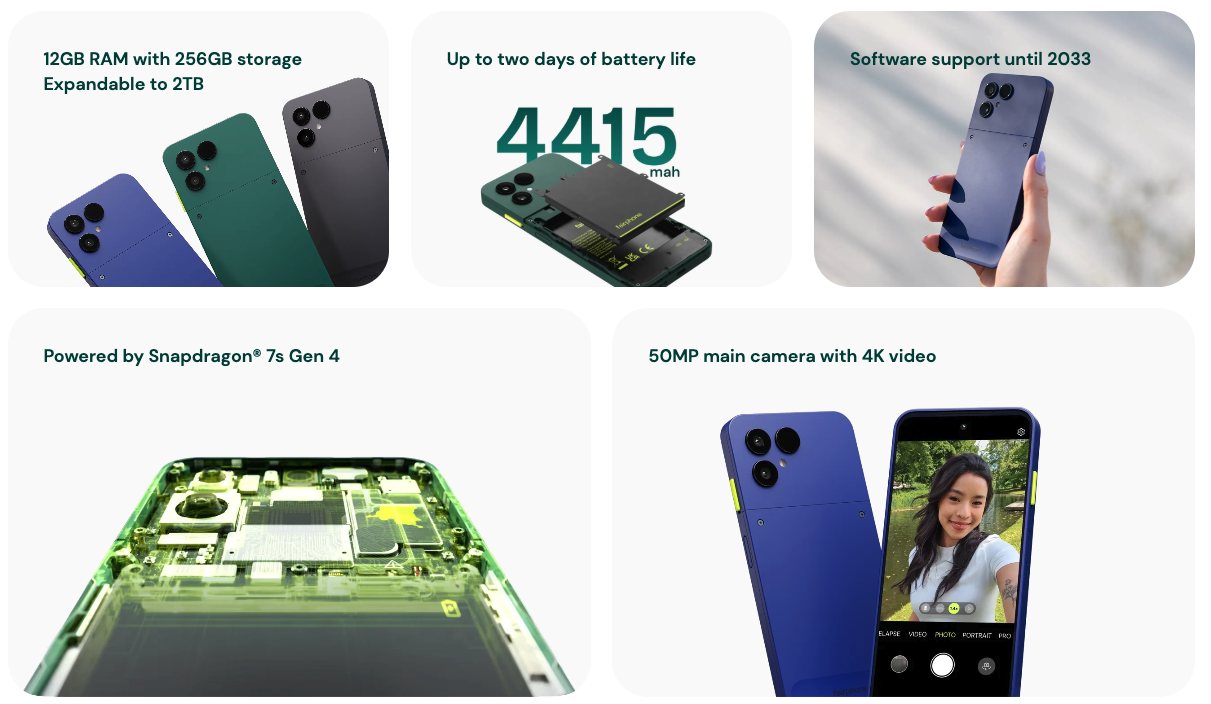
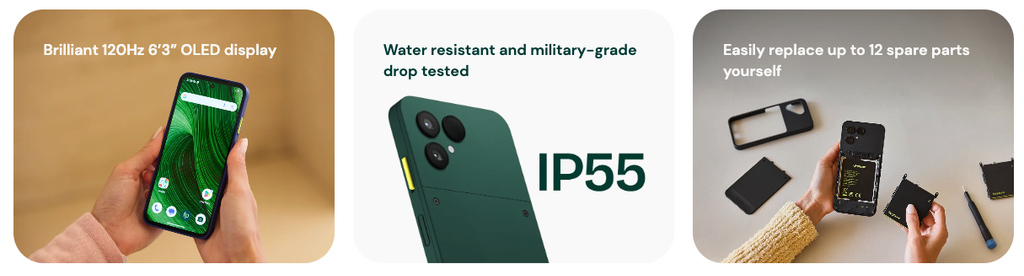
Performance doesn't end on the day of purchase. Fairphone offers a five-year warranty and software support through 2033, whereas a typical smartphone is often replaced after two to three years.
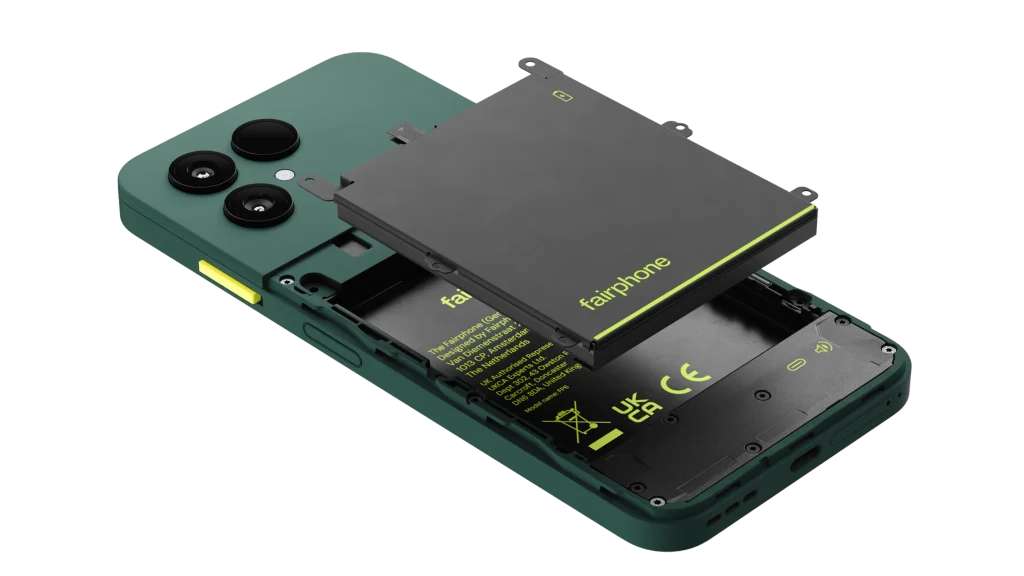

This durability is due to its modular design: up to twelve parts can be easily replaced, including the battery. For a corporate fleet, this means a device that remains fast and up-to-date over time, rather than equipment that needs to be replaced as soon as the first component fails.
While many manufacturers remain vague about the origin of their components, Fairphone makes this a priority. The device is made up of 51% fair-trade or recycled materials by total weight, including gold, silver, cobalt, copper, aluminum, and lithium. Its “Cobalt Blue” color is a deliberate nod to the brand’s origins, which stem from an awareness campaign on “conflict minerals.”
💙 When it comes to cobalt specifically, the approach is worth understanding. Since it’s nearly impossible to physically trace every gram of “clean” cobalt all the way to a battery, Fairphone uses a credit system: the brand pays a bonus corresponding to the amount it consumes, and this sum funds improvements to working conditions in artisanal mines. According to its 2025 Impact Report, the company thus covers 100% of its consumption of cobalt, gold, and silver. The goal is not to boast “perfect” cobalt, but to drive progress across the entire supply chain.
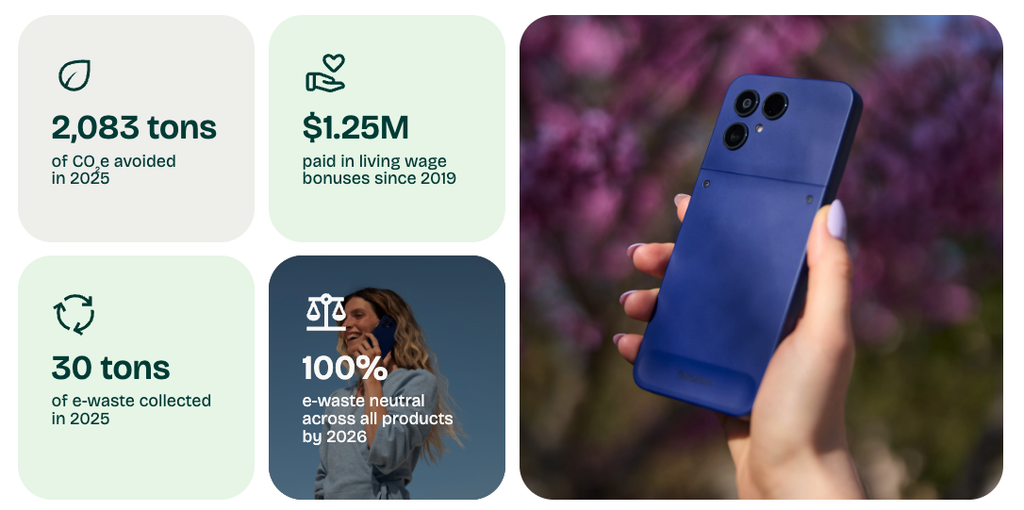
Beyond the device itself, the brand publishes its measured results. The Gen. 6 generation, from which this “Plus” version is derived, has a product carbon footprint of 29 kg CO₂e, a 30% reduction compared to the previous model, thanks in particular to the use of renewable energy in key manufacturing stages (assembly, display, camera, battery). Across its entire 2025 production, Fairphone claims 97% e-waste neutrality and has collected 30 metric tons of e-waste.
The social component is also quantified: in 2025, the brand paid $215,000 in bonuses aimed at ensuring a living wage for 1,650 workers across five supplier factories, bringing the total to more than $1.25 million.
✅ Overcoming this compromise does not require a complete overhaul of your purchasing policy. It is primarily a matter of reconciling, within a single selection framework, two sets of criteria: on the one hand, expected performance (power, battery life, software support duration); on the other, responsibility (repairability, percentage of recycled or ethically sourced materials, verifiable certifications). These are two complementary requirements, not two opposing camps.
This approach also benefits from incorporating reuse: combining new, eco-designed equipment with refurbished devices tailored to specific uses, and then managing the second life of devices being phased out. This is precisely the role of a fleet management partner like bconnex: helping companies develop a procurement strategy that balances performance and responsibility, sourcing the right equipment, and maximizing the value of equipment at the end of its useful life.
For a long time, buying responsibly meant accepting slightly lower performance. That is no longer the case, and that is precisely what’s new: the most environmentally friendly products are now also among the most durable and technically advanced.
💡 Before every purchase, the right question is therefore twofold, and not contradictory: “Does this equipment offer the performance we need?” and “Do we really know where it comes from and how it was made?” Being able to answer “yes” to both turns a simple purchase into a truly strategic choice.
